
How to Select a Commercial Pool Dosing System ↗
A practical pool dosing selection checklist: circulation, chlorine demand, sensors, pumps, interlocks, BMS interfaces and the information needed for a quote.
Water parks need a clear relationship between attraction water loops, peak demand and operator oversight. Central visibility can help a control room, while each circuit retains the measurements and safeguards needed for its own duty.
Document which pools, slides and water features share treatment water and which have separate circulation. Give each loop a unique name that appears on the drawings, controller display and alarm schedule. Record volume, flow and operating pattern for each one.
Do not assume that a shared control room means shared dosing control. The representative sample point and injection response must be reviewed for each hydraulic loop. Changes to an attraction’s operating schedule may also change how that loop is monitored.
Provide attendance patterns, attraction schedules, make-up arrangements and existing chemical consumption records. These inputs help the responsible designer assess changing demand and whether peaks occur at the same time. A single average daily consumption figure may hide the most demanding period.
Select pumps for controllable delivery at the required pressure. Review mixing and sample transport delays before tuning automatic chlorine or pH control. No-flow or invalid-measurement conditions must have a defined response rather than leaving an uncontrolled feed command active.
A useful central screen identifies the loop, value, units, alarm and time. Specify which readings and statuses operators need, then verify controller outputs and communication interfaces. Retain local permissives and fault handling when the supervisory network is unavailable.
Prioritize actionable alarms. An operator should know whether an alert concerns sample flow, low chemical level, a sensor fault or a measurement outside the agreed range. Define alarm routing and responsibility during busy periods and after closing.
If several loops share storage or on-site sodium hypochlorite generation, review simultaneous demand and how dosing is distributed. Generator output and storage cannot be selected from pool volume alone. Confirm the verified model data, utilities, ventilation and maintenance arrangements.
Provide access for sensor cleaning, pump service and tank inspection. Keep incompatible chemicals separated in the designed installation. Maintenance of one channel should have an agreed operating procedure so the effect on other loops is understood.
Send the loop schedule, drawings, instrument and pump list, existing control architecture and chemical records. Identify whether the work is a new installation, staged expansion or retrofit. Mark missing values instead of substituting assumptions.
Agree the supply boundary and acceptance checks before ordering: signal verification, sensor checks, pump response, flow interlocks, alarms and operator documentation. Our role is equipment selection, supply and regional project coordination. Authority approvals, installation and operating procedures belong in a separately agreed project scope.
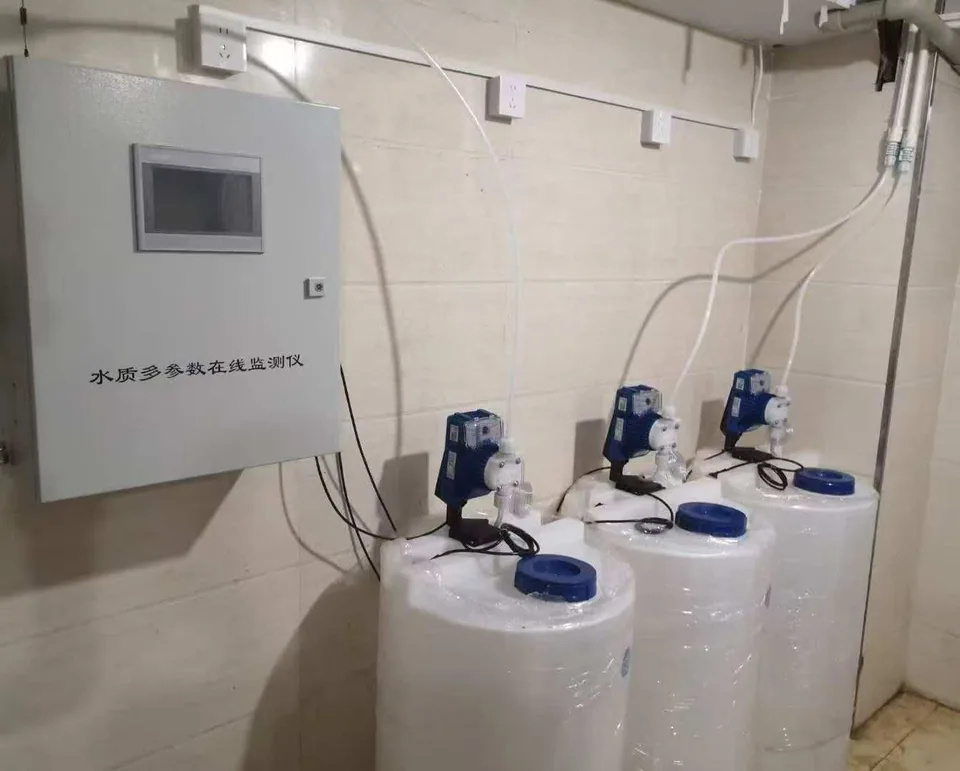
This supplied equipment photograph illustrates a cabinet, dosing pumps and tanks. It is not presented as a verified hotel or water park reference. Use your plant-room layout and circuit schedule to define the actual configuration.
A practical pool dosing selection checklist: circulation, chlorine demand, sensors, pumps, interlocks, BMS interfaces and the information needed for a quote.
Understand what ORP and free chlorine measure, why readings differ, and how to choose and verify monitoring for a commercial swimming pool.
Plan hotel and resort pool dosing around peak bather load, separate pools and spas, BMS signals, operator checks and practical retrofit requirements.
Review the complete pool dosing solution, monitoring equipment and Dubai pool-plan requirements before sending your project details.
Yes, a suitable design can consolidate readings and alarms, subject to supported interfaces. Each independent loop still needs its own appropriate measurement and control logic.
It can be evaluated against combined and peak demand, verified generator capacity, site utilities, storage and operating resources.
No. We collect engineering inputs for selection. Chemical rates and operating limits require project-specific engineering review.