
Conductivity monitoring
Measure conductivity to support the agreed blowdown strategy. Setpoints must be selected for your make-up water and treatment programme.
Coordinate measurement, dosing and blowdown around your cooling water circuit. Practical equipment solutions for hotels, commercial buildings and industrial facilities.
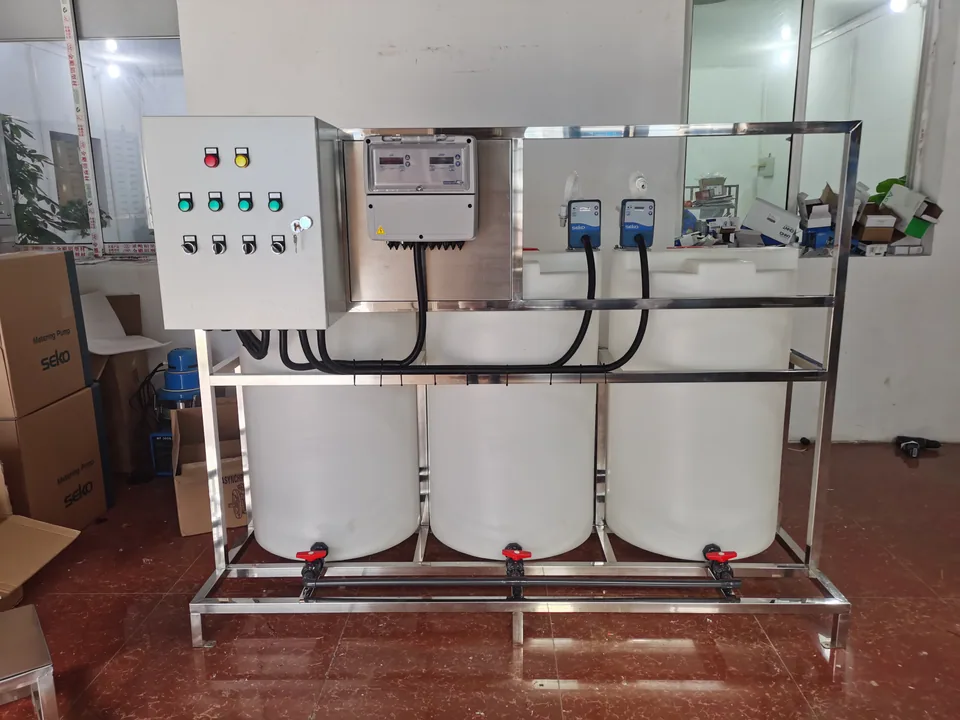
This tank-based dosing assembly illustrates how controls and chemical feed equipment can be arranged together. Cooling-water selection then adds the appropriate conductivity monitoring, blowdown interface and treatment-programme requirements.
Equipment configuration example; not identified as a cooling-tower installation.
Cooling water conditions change with make-up water, evaporation and operating load. Select monitoring and dosing equipment to support the treatment programme defined for your facility.
Components are selected to work together. Final scope depends on your application and confirmed technical requirements.
Measure conductivity to support the agreed blowdown strategy. Setpoints must be selected for your make-up water and treatment programme.
Use appropriate measurements where required by the treatment programme. Confirm sensor suitability and sample conditions.
Select metering pumps and tanks for the specified treatment chemicals, dose rates, materials compatibility and operating pressure.
Coordinate conductivity measurement, controller logic and the selected blowdown valve, with suitable operating safeguards.
Review any corrosion monitoring requirement and available equipment interfaces with the treatment specialist. Measurements support, rather than replace, the treatment programme.
Optional data and alarm integration depends on the selected controllers, communication interfaces and site network.
We focus on equipment supply, system selection, technical support and project coordination. Chemical programmes and site operating procedures should be defined by the responsible project specialists.
Map the circuit boundary before selecting treatment equipment. District cooling facilities may include open evaporative tower circuits as well as separate closed chilled-water networks. Their water chemistry and control requirements differ. Identify which circuit the proposal covers rather than applying a tower blowdown design to a sealed network.
Industrial facilities also need a review of process contamination, materials and operating schedules alongside the water analysis.
Make-up flow can provide a proportional dosing input where the treatment programme and equipment support it. A circulation-flow permissive helps prevent chemical feed into a stopped circuit. Distinguish a measurement used for proportioning from a switch used to confirm flow.
Review the instrument and controller interface principles, then define cooling-specific sensors and sample conditions. See the dosing and monitoring equipment scope for the components to coordinate.
In an evaporative cooling tower, evaporation concentrates dissolved salts. A conductivity sensor provides feedback to a controller, which operates the blowdown valve against the agreed settings. After blowdown and make-up water change the circuit, the sensor measures the response and the controller updates its action.
Here, “closed-loop” describes feedback control. It does not mean that an open evaporative cooling tower is a sealed water circuit. Closed cooling systems require a different treatment and monitoring review; evaporation-driven blowdown logic should not be copied into them automatically.
Separate dosing channels follow the selected chemical programme. Define deadband, maximum blowdown duration, flow checks and fault alarms to suit the actual system.
Review make-up water and circulating-water analysis before selecting conductivity limits. Conductivity tracks dissolved ionic content; it is not a complete scale or corrosion assessment. Temperature compensation and sampling conditions must suit the instrument.
pH monitoring supports the treatment specialist’s operating window. Inhibitor dosing may follow make-up flow, a timer or a measured residual where suitable equipment is provided. Conductivity alone does not directly measure inhibitor concentration.
ORP may support control of an oxidizing biocide programme after site-specific review. It is not a universal concentration measurement. Non-oxidizing biocides may require a scheduled or batch strategy rather than an ORP control loop.
Corrosion coupons or suitable online probes provide information about metal loss or corrosion behaviour. Confirm materials, placement, exposure or measurement method and interpretation with the treatment specialist. pH and conductivity cannot replace direct corrosion assessment.
Where the programme requires contact time, coordinate dosing with the permitted blowdown hold period. Define maximum limits and fault behaviour. Automatic dosing does not replace microbiological verification or the facility’s water-management procedures.
Agree which values, trends and alarms the BMS needs, then confirm controller protocols and interfaces. Define who receives alarms and what happens if the network fails. Local operating safeguards should remain effective without remote connectivity.
Verify sensor readings, pump delivery and valve operation against the agreed design. Test the response to loss of circulation, low chemical level and invalid readings. Review trends with the treatment specialist before changing settings.
Record baseline water analysis, control settings and inspection responsibilities so operators can distinguish a treatment change from an instrument fault.
Share the number of towers or circuits, make-up and circulating-water analysis, system materials, normal operating temperature, make-up flow records, existing chemical programme and controller details. Include available injection pressure, tank space and the required BMS signal list.
Discuss a cooling-water equipment scope ↗We can coordinate the equipment scope, including appropriate instruments, controllers, metering pumps and dosing systems, based on confirmed project requirements.
Potentially. Confirm the required protocol, signals and available controller interfaces before equipment selection.
The website scope is equipment supply and technical or project coordination. A site-specific chemical treatment programme must be agreed with the responsible treatment specialist.
Equipment supply, system selection and project coordination for UAE, Saudi Arabia and GCC customers.